More than a Visit
July 1, 2026
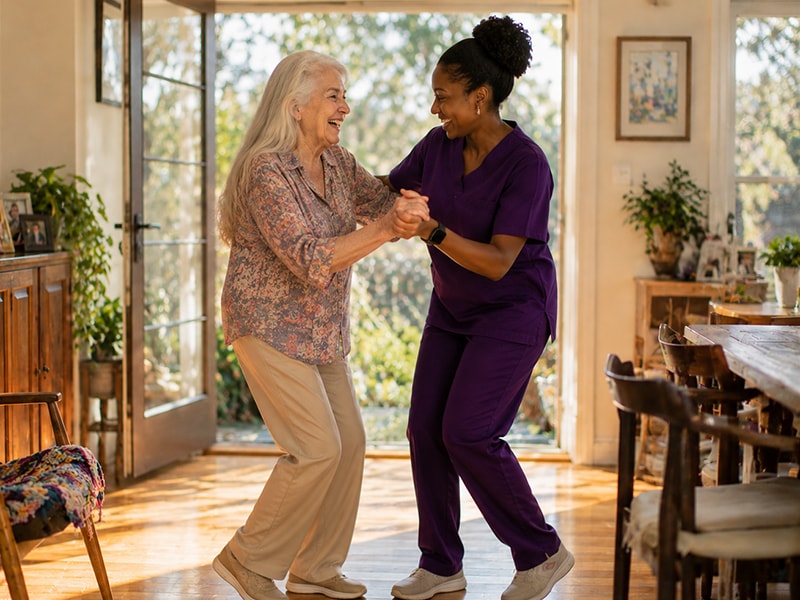
Why the Company a Support Worker Brings is as Important as the Service they Provide.
Think about what a carer does when they arrive at someone’s home.
They might make a meal. Help with medications. Assist with a shower. Tidy the kitchen. Tick the boxes, check the tasks, and move on to the next visit.
But here is what the best carers know, and what research confirms, that what truly matters in those few short hours is not just what gets done. It’s the fact that someone showed up. That someone asked how they slept. That someone remembered the name of the grandchild in the photo on the fridge and genuinely wanted to know how the school play went.
For many older Australians, a Support Work’s visit is the most meaningful human contact they will have that day. Sometimes that week.
That is a profound responsibility, and it’s one we take seriously at Chris Barnard Health.
A World that Can Feel Like it has Moved on From You
Ageing in Australia can be an isolating experience. Friends pass away. Families get busy. Mobility fades. The world outside the front door starts to feel a little further away each year, and the silence inside yourself and the home grows a little louder.
According to research published in the Medical Journal of Australia, 28.5% of people aged 60 and above experience some degree of loneliness. For those living in residential care, the figures are even more stark – studies estimate that 61% experience moderate loneliness and 35% severe loneliness. Something you don’t expect when being surrounded by people all the time.
46% of Australians aged 75 and over rate their level of social support as low, and over a third report feeling lonely on a regular basis. Something we can all relate to is that since the COVID-19 pandemic, the situation has worsened, loneliness has risen from affecting one in four Australians to one in three today, according to Ending Loneliness Together’s national report.
These are not just statistics. They are people. People with stories, with histories, with whole lives lived, who now spend long stretches of the day without anyone to share them with. Could you imagine being that lonely?
What Loneliness Actually Does
Loneliness is not a feeling we at Chris Barnard Health dismiss as simply part of getting older. The health consequences are real, measurable and serious.
Research published in the Medical Journal of Australia found that loneliness increases the risk of premature death by 26% and social isolation by 29%. Studies also link chronic loneliness to a 29% increase in heart disease risk, a 32% increase in stroke risk, and a 50% increase in dementia risk.
Clinical researchers have drawn a striking comparison: chronic loneliness carries health risks equivalent to smoking up to 15 cigarettes a day. It triggers inflammation and hormonal dysregulation in the body. It’s not a soft issue. It’s a physiological one, as real and as dangerous as any condition a support worker might help manage.
The cost to the Australian economy alone is estimated at $2.7 billion per year. But no economic figure captures what it actually feels like to go through an entire day without anyone to talk to. It begins to feel like a trap.
The Flip Side: What Connection Gives Back
If isolation takes years off a life, connection adds them back.
A landmark meta-analysis of over 300,000 people found that those with strong social relationships had a 50% increased likelihood of survival compared to those with weaker social ties, a survival advantage on par with quitting smoking. The 85-year Harvard Study of Adult Development, one of the longest-running studies of human health and happiness ever conducted, found that the quality of our relationships is the single strongest predictor of how long and how well we live.
As the study’s director Dr Robert Waldinger put it: “People who are more socially connected to family, to friends, to community, are happier, healthier, and live longer.”
To be clear, it’s not about how many people you know. It’s about depth, not breadth. Research consistently shows that emotional support, like having someone to talk to, to confide in, to feel genuinely understood by is what matters most for mental health and longevity in older adults. A kind, consistent, trusted presence in someone’s life can be transformative.
A Good Support Worker has the Power to Change Everything
This is where our Support Workers come in, and why their role is so much more than the task list in their schedule.
When a Chris Barnard Health Support Worker arrives at someone’s door, yes, they are there to help with the practical things. The cooking. The cleaning. The personal care. Those things matter deeply and we take pride in doing them really well and in a manner that pleases the client.
But they are also there to be a human being with another human being. It could be as simple as sitting down with a cup of tea and actually listening. To notice when someone seems quieter than usual. To laugh at the same story, they have heard three times before, because the telling of it brings them joy. These actions speak louder than words and they say: I see you. I am here. You matter.
Research from Monash University published in 2026 found that older Australians without close family ties were nearly three times as likely to experience severe loneliness and that formal care services, however excellent, cannot fully substitute for genuine emotional connection. We cannot replace family. But we can be a steady, warm, trusted presence in a life that might otherwise feel very quiet.
More Than a Job. A Calling.
The Support Workers we are proud to work with understand this intuitively. They do not clock in and clock out. They notice, remember and genuinely care, not because it’s on the task list, but because they understand that the person in front of them has lived a full, rich, remarkable life and deserves to be treated accordingly.
In a world that sometimes moves too fast to notice its older citizens, our Support Workers slow down. They pull up a chair and ask the questions that matter.
That is what All Care, All Heart means to us. Not just physical care delivered efficiently, but human connection offered genuinely, visit after visit, day after day.
The Chris Barnard Health Commitment
With connection being one of the most powerful determinants of health and longevity in older Australians, our Support Workers truly shows up, not just physically, but emotionally, and aim to make a measurable difference in the lives of our clients.
At Chris Barnard Health, we believe that every visit is an opportunity to remind an older Australian that they have not been forgotten, they are valued and that someone, today, chose to get up and be there with them.
That is the care we are committed to providing and we would not have it any other way.
Click here for more information on Support at Home at Chris Barnard Health or call 1300 602 469.
Sources & References
- Holwerda, T.J. et al. (2024). “The loneliness epidemic: a holistic view of its health and economic implications in older age.” Medical Journal of Australia, 221(6).
- Ko, P.C. et al. (2026). “Family ties, kinlessness, and loneliness among older Australians.” Archives of Gerontology and Geriatrics, 106192. Monash University.
- Ending Loneliness Together (2023). State of the Nation: Social Connection in Australia 2023. Australian Government-funded report.
- Australian Institute of Health and Welfare (2023). Social isolation and loneliness data — Australians aged 65 and over.
- Holt-Lunstad, J., Smith, T.B. & Layton, J.B. (2010). “Social Relationships and Mortality Risk: A Meta-analytic Review.” PLOS Medicine, 7(7). Meta-analysis of 308,849 participants.
- Waldinger, R. (2023). Harvard Study of Adult Development — 85-year longitudinal study on happiness, health and relationships. Harvard Medical School.
- Samtani, S. (2026, February). “Promoting social connections for better mental health in older adults.” InSight+ / Medical Journal of Australia.
- Justice and Peace Office (2024). “Social Isolation and Loneliness in Older Adults.”
- Johnstone, G. et al. (2025). “Loneliness and its associated factors in older Australians residing in retirement living communities.” BMC Geriatrics, 25, 448. Bolton Clarke Research Institute / Monash University.
- Australian Bureau of Statistics (2024). Measuring What Matters — Social Connections.
By Shehal Gomas
Operational Manager